

Dehumidifiers are becoming popular due to their health benefits of clearing damp and condensation in the home. But with rising energy costs, we will cover the power usage and cost of electricity to run.
In this article we will answer the following questions:
- How Much Power Does A Dehumidifier Use?
- Is A Dehumidifier Expensive To Run?
- Buying A New Dehumidifier? What To Look For?
- Should A Landlord Pay the Electric Running Costs of a Dehumidifier?
How Much Power Does A Dehumidifier Use?
The electricity consumption of domestic dehumidifiers may vary slightly depending on the make, model and capacity of the unit.
A typical home dehumidifier will use between 0.14 kWh and 1.20 kWh.
Newer appliances are generally more efficient to run than older models.
Case Study
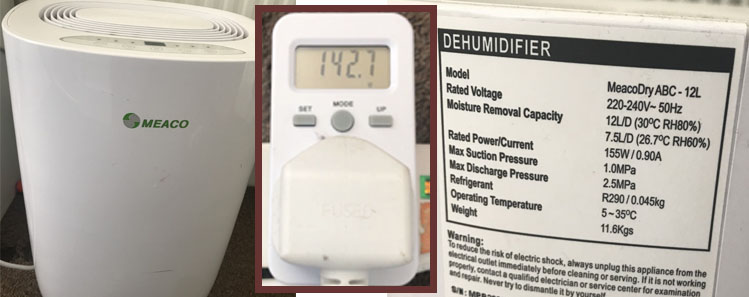
In this case study we used a Meaco MeacoDry ABC 12L medium sized domestic dehumidifier purchased in 2021. The moisture removal capacity is 12L/D (30C RH80%).
With dehumidifiers the numbers mean in this case 12L/D (30C RH80%). 12 litres of water removed per day from a room at 30°C with Relative Humidity of 80%. (Note: RH of 50% is typical in a room without damp).
The unit pulls 140w of electricity when running. There is no standby mode therefore it doesn’t draw any power when switched off using the panel power switch.
In this article, we will use 140w as the base example of how much power is used by a dehumidifier.
Is A Dehumidifier Expensive To Run?
Dehumidifiers are considered to be expensive to run in comparison to other devices and home appliances because to work effectively they are required to be left on for long periods of time.
To add a comparison in order to put this into context, here are other devices that run for long periods of time:
| Appliance | Wattage Usage |
| TV (32″) | 70w |
| Wifi Router | 6w |
| Dehumidifier | 140w |
How Much Does It Cost To Run A Dehumidifier?
The running costs can be calculated by dividing the watt (w) consumption by 1000 and multiplying by kilowatt hour (kWh) that your energy supplier currently charge you.
(w)/1000 x (kWh rate) = cost per hour.
140w / 1000 = 0.14.
A modern home dehumidifier uses (140w) 0.14 kWh.
Multiply this number (0.14) by the tariff rate per kWh that your energy supplier charges you to calculate an hourly running cost.
Here is a quick example of running costs uses the rate of £0.52p kWh from the supplier.
If you run the dehumidifier for 6 hours every day, the cost is £0.44 per day and £13.50 per month.
(We have created a spreadsheet to calculate kWh costs. This can be downloaded free here).
Cost Examples Of Running A Dehumidifier
In this table, we have used the (140w) watt that was drawn from the unit in our case study and used the average cost of electric per kWh in some example countries. These rates were correct in October 2022.
“Per Month” prices are on the calculation of running the appliance for 6 hours per day for 31 days.
Prices are displayed in the local currency for each country.
| Country | kWh Rate | kWh Usage | Cost Per Hour | Per Month @ (6hrs p/day) |
| Australia | $0.40 | 0.14 | $0.05 | $10.42 |
| Canada | $0.18 | 0.14 | $0.03 | $4.69 |
| Czech Rep | Kč 5.9 | 0.14 | Kč 0.82 | Kč 154 |
| Denmark | kr 8.42 | 0.14 | kr 1.18 | kr 219 |
| France | €0.11 | 0.14 | €0.02 | €2.86 |
| Germany | €0.32 | 0.14 | €0.04 | €8.33 |
| India | ₹6 | 0.14 | ₹0.84 | ₹156 |
| Indonesia | rp 1348 | 0.14 | rp 188 | rp 35,100 |
| Netherlands | €0.15 | 0.14 | €0.02 | €3.91 |
| Poland | zl 0.75 | 0.14 | zl 0.10 | zl 19.53 |
| Ireland | €0.30 | 0.14 | €0.04 | €7.81 |
| UK | £0.52 | 0.14 | £0.07 | £13.54 |
| USA | $0.13 | 0.14 | $0.02 | $3.39 |
Buying A New Dehumidifier? What To Look For?
Dehumidifiers aren’t all the same.
Things to take into consideration when buying a dehumidifier:
- Capacity
- Dehumidifier Type
- Additional Filters Such As Carbon & PET (Polyethylene Terephthalate)
- Power Consumption
- Noise
Capacity
Depending on the level of damp or condensation, a dehumidifier could remove as little as 0.5 litre per day from a small room, to 20 litres per day in a much larger room.
The capacity is worth considering as this will determine how moisture that the unit will remove from the air and how often the water tank will need emptied.
A dehumidifier will switch itself off once the tank is full.
Dehumidifier Types
There are 3 main groups.
- Compressor
- Desiccant
- Peltier
Compressor Dehumidifiers
Ideal for removing damp air from rooms within the house.
These are best for dealing with damp in rooms inside a house. They draw in the air using a fan system and using a coil system similarly found in fridges. They collect the water in the air and pump out warmer and drier air.
The water is collected in a tank.
Desiccant Dehumidifiers
Ideal for removing damp from colder areas such as uninhabited spaces, attics and garages.
Desiccant dehumidifiers use an internal rotating wheel to filter the air that is drawn in by the fan. Another internal fan system removes the internal moisture into a water collection tank.
Peltier Dehumidifiers
Ideal for targeting small spaces such as walk-in wardrobes and very small rooms in the home.
Peltier dehumidifiers draw the damp air which passes over a cold heat sink. This condenses the moisture which drips into the removable water tank.
Additional Filters
Some modern dehumidifiers come with additional filters such as carbon filters & PET (Polyethylene Terephthalate) filters. These can be used to filter dust, reduce allergies and also remove odours from a room.
When Buying A New Dehumidifier – Check Power Consumption
When purchasing a new dehumidifier, on the manufacturer or sellers technical details listing, you will be able to check power consumption. This is usually in (w) watt.
A good benchmark for a unit that is intended to run in a medium sized room is 150w maximum.
Most new electrical appliances of this sort are designed now with energy efficiency in mind so this shouldn’t be an issue when buying new.
In fact, most new electrical appliances use their “eco-efficiency” as a main selling point now.
Noise
When buying a new dehumidifier, a consideration overlooked is how loud a noise they make.
You may decide to run the unit when your electricity rate is off-peak. Off-peak tariffs are often at night.
A good benchmark to look for is 36db (db decibel). You can compare 36db to a domestic fan running. Anything much louder than this level should be avoided if you plan on running your dehumidifier at night.
Should A Landlord Pay the Electric Running Costs of a Dehumidifier?
This answer applies in the UK for private rentals.
A landlord is responsible for dealing with costs relating to rising damp. In order to rent out a property, the landlord must ensure that the property is free from any health hazards.
Failure to promptly act on repairing issues of damp would put them in breach of the code of the Housing Health and Safety Rating System (HHSRS).
The advice is to contact your local council authority and seek advice. They will likely arrange for a member of their Environmental Health department to come and assess the property. Even if the property is rented privately there is no charge for this.
Once the report is complete and you can prove that a dehumidifier is necessary until proper repair work is carried out, it is the responsibility of the landlord to pay any additional costs due to damp, including the running costs of dehumidifiers.
Actual legislation however differs slightly from council to council and is not national. Your Environmental Health office at your local council will advise you on the procedure.
Over 70% RH (relative humidity) in a room is considered unacceptable and over long period of time will cause mould and contribute to health issues. Whereas a level of up to 50% RH is considered acceptable for comfort & health.
Video To Accompany This Article
About This Article
Normally this channel is dedicated to computer related issues, however we aim to provide clear information about the running costs of home electrical devices and appliances.
With the rising costs in energy prices in 2022, this series of articles will cover energy saving information on all types of home tech & appliances.
The information that I found on the internet about the power consumption of home appliances was mostly inaccurate and therefore misleading.
It’s almost as if some blog writers on the internet just rely on data from other sites without carrying out the tests themselves!
Therefore, every article in this series is backed up with our own actual case studies, having taken our own measurements of the information inputted into the calculation results. This data will be shown in the accompanying video clips with this series.
Thanks
If this support information has helped, please subscribe to our YouTube channel for more tips, tutorials & technical support.
End.
Links:
How Much Power Does My WIFI Router Use?
Electricity Watt Usage Price Spreadsheet